Designing a Cross-Team Launch System for US Cellular
The Moment Everything Moves
Every September, the technology world pauses for the annual product launch from Apple.
But for wireless carriers like US Cellular, the moment Apple announces new devices is not just a press event — it's a race against time.
Within minutes of the announcement, customers flood carrier websites to explore devices, compare deals, and place pre-orders. If the website isn’t ready, the company risks losing sales, frustrated customers, and missed market momentum.
In 2025, I helped US Cellular prepare its digital ecosystem for the Apple Fall Launch.
My challenge was not designing a single screen or page. My challenge was designing a system that allowed multiple teams to launch together.
Apple Fall New Product Introduction (NPI)
2025 | Amdocs | USCC
My Role
Content Planner + Designer
I worked at the intersection of strategy, design, and operational planning, translating Apple’s confidential launch information into a clear internal roadmap for execution.
My responsibilities included:
Designing the Apple NPI launch timeline
Aligning cross-functional teams
Planning website content architecture
Converting strategy into development workflows
Overseeing launch readiness
Teams involved included:
Marketing
Development
Merchandising
Accessibility
QA
Product Owners
Stakeholders
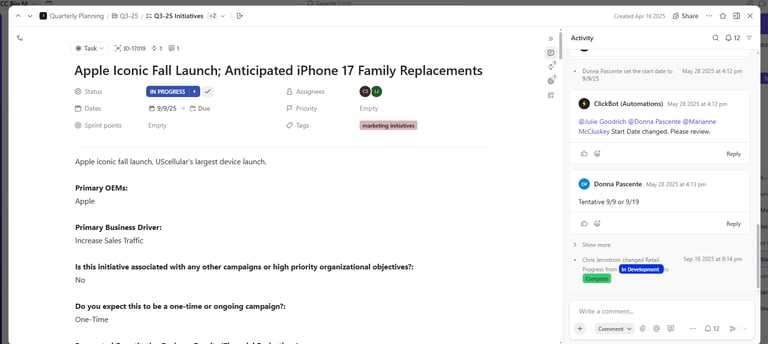
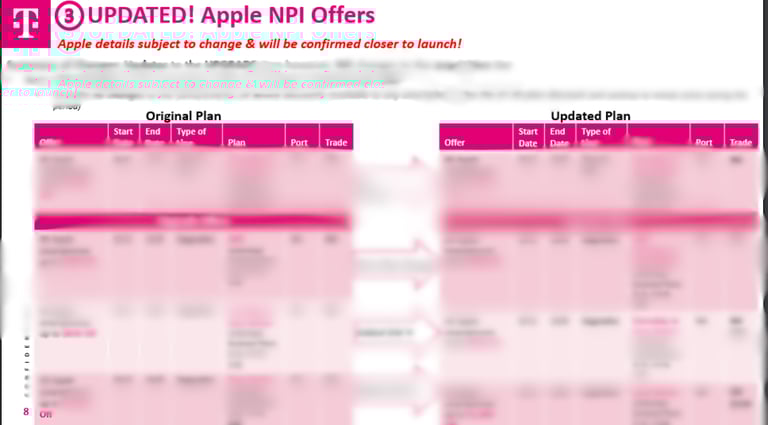
Preparing for an Apple launch is uniquely complex.
Information arrives slowly and confidentially, often weeks before public announcement. Teams must prepare the website without knowing final product names or marketing assets.
Instead, we receive:
Tentative announcement dates
Pre-order timelines
Device code names
Early marketing signals
At the same time, the website must prepare for multiple launch-day experiences, including:
Device pages
Promotional deals
Accessory bundles
Marketing campaigns
All of this must be ready the moment Apple publicly reveals the products.
Without coordination, teams risk working in silos and missing the launch window.
I realized the real problem wasn’t just content or design - The real problem was coordination.
The Challenge
Reframing the Problem
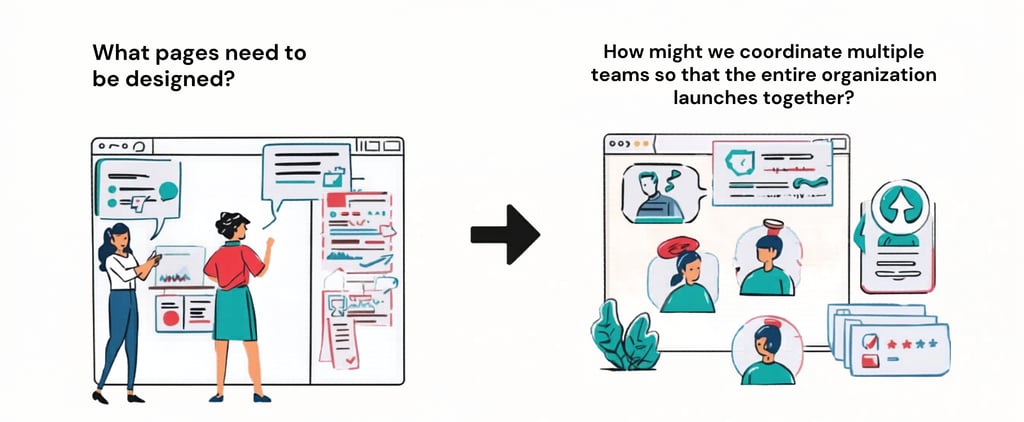
Instead of asking:
"What pages need to be designed?"
I reframed the problem to ask:
"How might we coordinate multiple teams so that the entire organization launches together?"
This shifted the focus from designing pages to designing a launch system.
Designing the Launch System
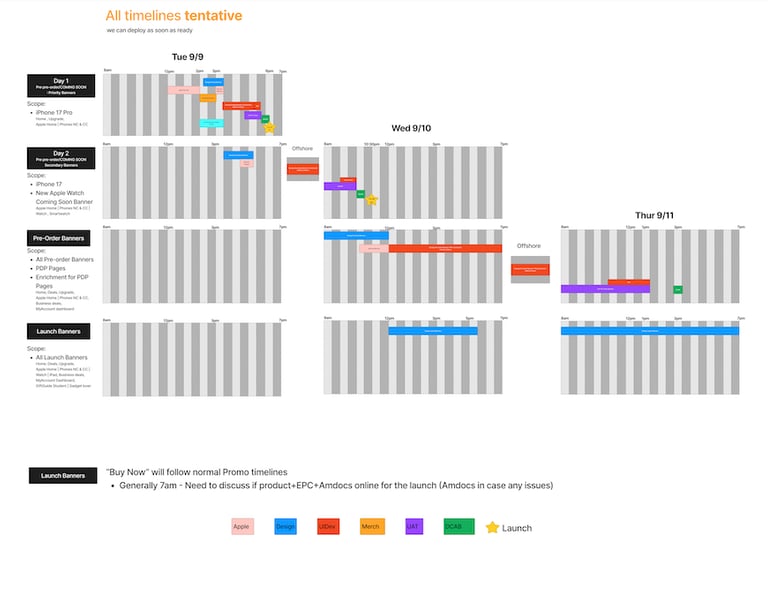
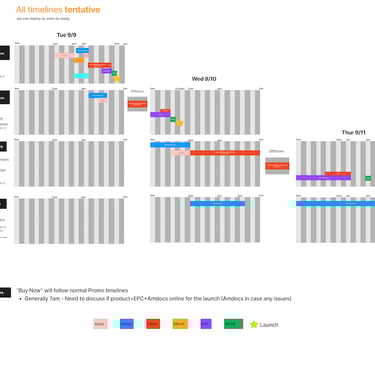
To solve this, I created a visual NPI timeline framework using Figma.
The timeline mapped the entire Apple launch lifecycle, including:
Announcement preparation
Pre-order readiness
Launch day execution
Each phase included:
Daily tasks
Team ownership
Cross-team dependencies
The timeline was structured as swim lanes, where each row represented a different team and each column represented a day in the launch window.
This allowed teams to instantly see:
When their work started
What other teams depended on them
What had to be completed before launch day
Instead of scattered conversations and documents, the organization now had one shared roadmap.
Reframing the Problem
Aligning the Organization
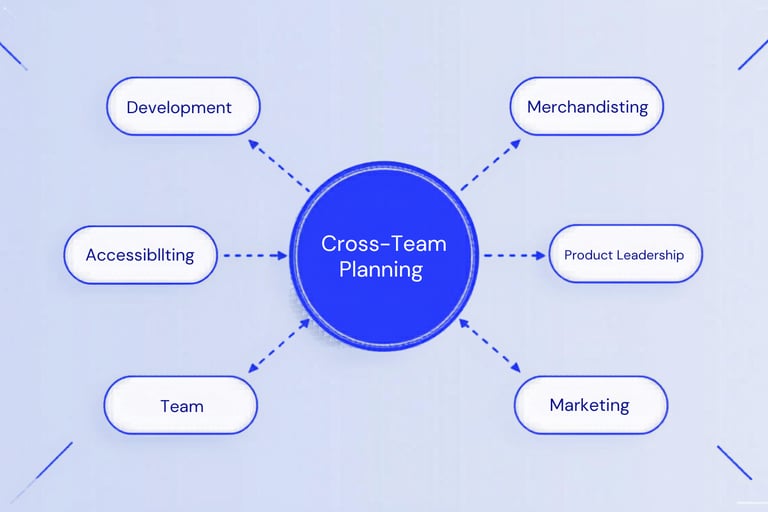
Once the timeline was created, I organized a cross-team planning session.
Participants included teams from:
Development
Merchandising
Accessibility
QA
Product leadership
Marketing
Rather than presenting a static plan, I used the timeline as a collaborative artifact.
Teams discussed:
Potential risks
Dependencies between tasks
Workload distribution
Launch-day responsibilities
By the end of the session, the timeline evolved from a planning document into a shared operational framework.
Preparing the Digital Experience
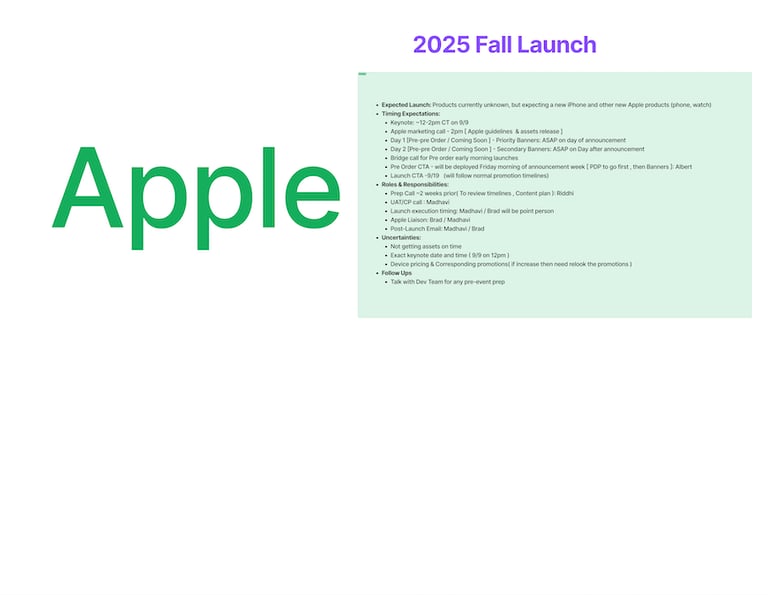
With alignment achieved, the next step was preparing the US Cellular website for the Apple launch experience.
I led content planning across key areas of the site:
• Apple product landing page
• Deals and promotions page
• Accessories pages
• Device listing pages
Because product names were still confidential, planning relied on Apple code names, allowing design and development work to begin before the public announcement.
This ensured the website infrastructure was ready to swap in final assets quickly once Apple announced the devices.
Turning Strategy Into Execution
Planning alone does not launch products — execution does.
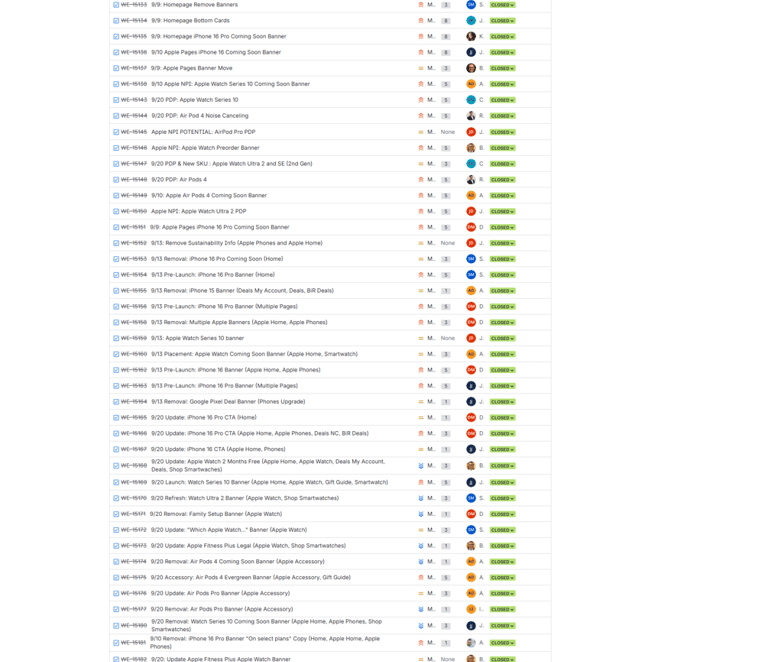
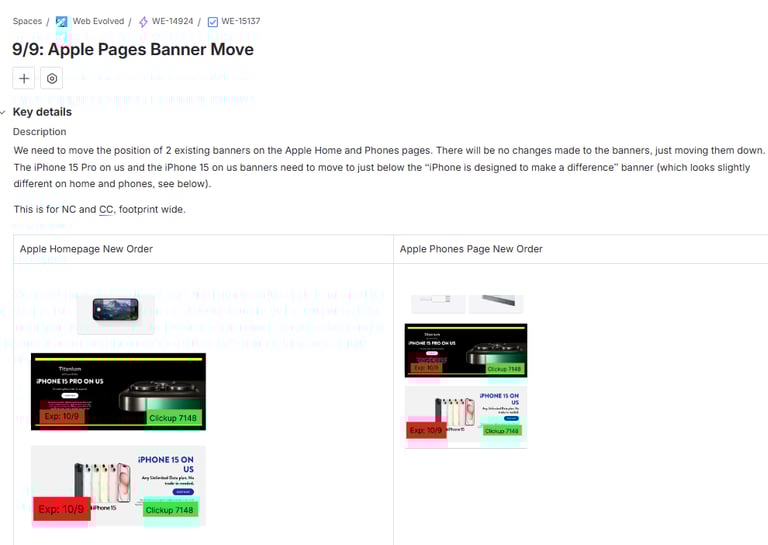
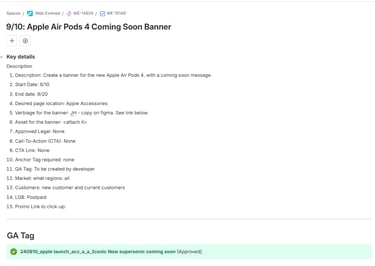
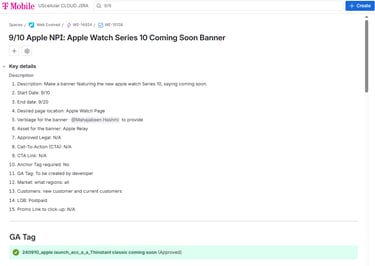
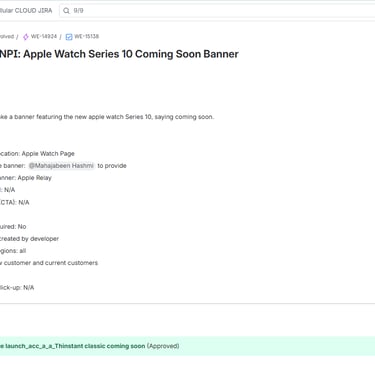
To operationalize the launch system, I translated the timeline into development tasks using Jira.
I created a dedicated Apple Launch Epic that contained detailed tickets for:
Page updates
Promotional placements
Design tasks
Content updates
Accessibility checks
Legal requirements
Legal content and disclaimers were coordinated through ClickUp.
Each ticket is clearly defined:
• Scope
• Owner
• Deadlines
• Affected pages
This allowed development teams to move through the work using their existing agile workflow
Launch Readiness
As development progressed, I monitored ticket progress and helped resolve questions or dependencies between teams.
Once development was complete, the new features were deployed to pre-production.
I conducted a final review to ensure:
• Promotional content appeared correctly
• Product pages functioned properly
• Layouts matched the design system
• Launch content was accurate
This final step ensured the website was ready for the moment Apple announced the new devices.
After
• A centralized launch timeline aligned the entire organization
• Cross-team collaboration improved significantly
• Development tasks were clearly structured
• Launch preparation became predictable and repeatable
What I Learned
This project reinforced an important lesson in product design:
Sometimes the most impactful design work isn’t a screen.
Sometimes it's designing the system that allows teams to move together.
By creating a shared planning framework, I helped transform a complex launch process into a coordinated cross-team operation.
Impact
The timeline framework transformed the Apple launch preparation process at US Cellular.
The timeline framework has since served as a reusable model for future product launches.
Before
• Planning information lived across multiple conversations and documents
• Teams lacked a shared roadmap
• Dependencies were difficult to track
• Website updates were reactive
The timeline framework has since served as a reusable model for future product launches.


Design
Crafting user-centric experiences with creativity.
About
Testimonials
+1 (519)965-3870
© 2025. All rights reserved.